11 minutes reading
AI Agent Security Awareness Training for Your Workforce

449
0

AI agent security awareness training teaches employees how to operate, supervise, and challenge autonomous AI systems safely. It covers approved agent use, permission scoping, recognizing manipulated agent output, and escalating unexpected agent behavior. The training matters because agents act with real credentials, and a human still approves the actions that cause damage.
AI agent security awareness training is role-based instruction that prepares employees for three jobs they did not have two years ago: choosing which agents to use, deciding what those agents may access, and approving or rejecting the actions agents propose. Traditional awareness programs cover none of that. They teach people to spot a malicious email, not to evaluate whether a confident-sounding agent should be allowed to issue a refund, change a record, or email a file outside the company.
The distinction matters because the failure mode is different. Phishing training targets recognition of a hostile message. Agent training targets judgment about a trusted tool. An employee who has been taught to distrust unexpected email will still click Approve on an agent request, because the agent is supposed to be there, and the request looks like work.
Vendors are building AI defenses to protect AI agents, and that work is necessary. It also leaves the decision layer untouched. Every enterprise agent deployment still routes consequential actions through a person who confirms them, and Verizon’s 2026 Data Breach Investigations Report found the human element present in 62% of breaches, up from 60% the year before, across a dataset of more than 22,000 confirmed breaches. Agents did not remove humans from the breach path. They gave humans faster, more convincing things to approve.
There is now direct evidence that the approval step degrades with use. A June 2026 preprint, Habituation at the Gate, analyzed 11,429 code reviews from 400 repeat reviewers of AI agent pull requests and found approval rates rose 14.5 percentage points across reviewer experience deciles while inline review comments fell 22%. Approval of human-submitted changes declined over the same period, so the shift was specific to agent work. The authors are careful that habituation is one explanation among several, but the pattern is the one every security team should plan for: the more an agent gets things right, the less carefully its work gets read.
That is a behavioral control decaying over time, which makes it a human risk management problem rather than an engineering backlog item. Behavioral controls are measured, baselined, and reinforced. They are not patched.
Discover how Threatcop protects your workforce from modern cyber threats.
The OWASP Top 10 for Agentic Applications, published by the OWASP Agentic Security Initiative, catalogs ten agentic risk categories from ASI01 through ASI10. Several are pure engineering problems. Several cannot be closed without changing what an employee does, and those are the ones an awareness program owns.
| OWASP risk | What the agent does | The employee behavior that decides the outcome |
| ASI01 Agent Goal Hijack | Follows hidden instructions planted in a document, email, or web page | Treating retrieved content as untrusted and questioning an agent whose plan changes mid-task |
| ASI02 Tool Misuse | Uses an authorized tool in an unintended way, such as deleting instead of reading | Requesting the narrowest permission set at provisioning time, not the convenient one |
| ASI03 Identity and Privilege Abuse | Inherits or reuses access it should not have | Refusing to share personal credentials or tokens with an agent for convenience |
| ASI04 Agentic Supply Chain | Loads a tampered plug-in, connector, or third-party agent at runtime | Installing only reviewed connectors, and reporting anything that appeared without a request |
| ASI06 Memory and Context Poisoning | Stores false context that shapes later decisions | Noticing when an agent asserts something it was never told, and flagging it |
| ASI09 Human-Agent Trust Exploitation | Produces confident output that justifies a harmful action | Verifying high-impact requests independently before approving them |
ASI09 deserves separate attention because it is the only entry on the list where the human is the exploited control rather than the compromised system. OWASP describes the pattern as people over-trusting confident agent output and approving something they would otherwise reject. No permission model fixes that. The mitigation is a trained approver plus a process that forces the check, which is why agent risk belongs in the same program as phishing and social engineering rather than in a parallel initiative.
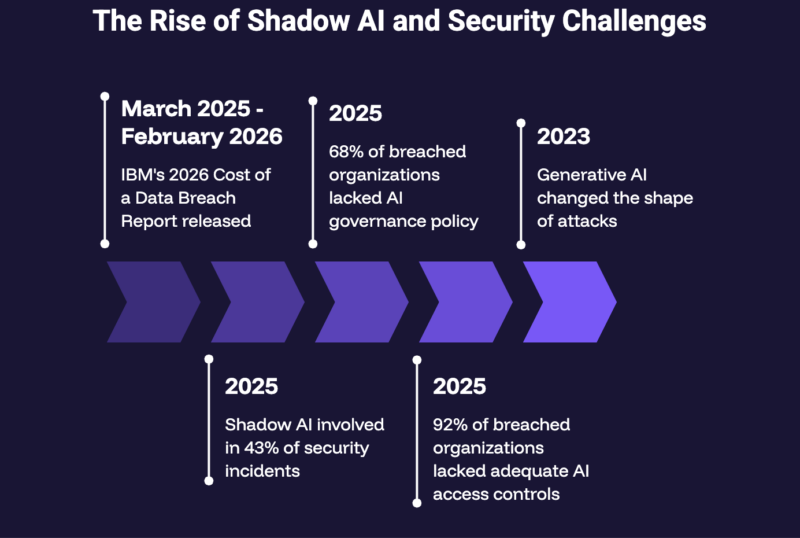
Shadow AI is the use of unsanctioned AI tools and agents without security review, and it has become the dominant AI exposure. IBM’s 2026 Cost of a Data Breach Report, based on 602 breached organizations studied between March 2025 and February 2026, found shadow AI involved in 43% of security incidents, more than double the 20% recorded the year before. The same research found 68% of breached organizations had no AI governance policy in place, and 92% of those with an AI-related breach lacked adequate AI access controls.
Read those three numbers together and the sequence is clear. Employees adopt agents faster than policy arrives, the agents get credentials nobody scoped, and the incident is discovered after the data has already moved. Blocking is not a working answer, because the tools that get adopted are the ones that remove real friction from real work. The answer is a sanctioned path that is easier than the unsanctioned one, plus a workforce that knows the difference and reports the gap.
The pattern is familiar to anyone who watched generative AI changed the shape of attacks two years ago. Capability arrives, adoption outruns governance, and the security team spends the following year retrofitting controls onto behavior that already happened.
For organizations operating in the EU, yes. Article 4 of the EU AI Act has applied since February 2, 2025, and the European Commission’s guidance on AI literacy states that providers and deployers must take measures to ensure a sufficient level of AI literacy among staff and anyone operating AI systems on their behalf, calibrated to each group’s technical knowledge, experience, and the context of use. The duty applies to deployers of any AI system, not only high-risk ones, so a company whose sales team uses a CRM with predictive features is in scope.
A second date has already passed. Article 50 transparency obligations became applicable on August 2, 2026 under the European Commission’s transparency guidance, covering disclosure that a person is interacting with an AI system, with a limited grace period until December 2, 2026 for marking AI-generated content in systems already on the market. Disclosure is executed by staff who configure and deploy customer-facing agents, which makes it a training requirement and not only a legal one.
Two practical notes for program owners. Article 4 is outcome-based, so it prescribes no format or certification, which means completion records alone are weak evidence and role-appropriate content plus retained delivery records are stronger. And the literacy duty is broader than the security case for it, covering opportunities, limitations, and possible harms, so a security-only module will satisfy the security team and not the regulator.
Agent risk concentrates by permission, not by seniority, so a single all-staff module leaves the largest exposures untouched. Role-based security awareness training is the structure that fits, and the role split that awareness programs already use for phishing maps cleanly onto agent risk: executives, IT, finance, HR, and remote or field staff each carry a different authority level.
| Role | Highest agent exposure | Training focus |
| Finance and procurement | Payment and invoice actions proposed by an agent | Independent verification of payees and amounts outside the agent interface, before approval |
| Executives and assistants | High-authority approvals delegated at speed | Recognizing manufactured urgency in agent summaries, and refusing approvals without a source trail |
| Developers and IT | Coding agents with repository and production access | Separating code generation from execution, reviewing generated commands, and scoping tokens per task |
| HR and legal | Agents processing candidate, employee, and contract data | Data minimization before upload, plus disclosure duties when an agent is customer or candidate facing |
| Customer support | Agents with refund, credit, and account-change tools | Confirming that a requested action falls inside the agent’s intended purpose, and escalating when it does not |
| All employees | Unsanctioned agents and connectors | The approved agent list, what may never be pasted into an agent, and how to report unexpected agent behavior |
Delivery decides whether that table survives contact with a calendar. Role-based, category-based training of the kind Threatcop’s TLMS delivers works here because a finance approver and a developer need different scenarios, different lengths, and often different languages, and content people actually finish is the only content that changes what they do at the approval screen.
The content that carries across every role is a short list of non-negotiables: never share personal credentials with an agent, never grant standing access where task-scoped access will do, treat any document or email an agent read as potentially hostile input, and escalate an agent that acts outside its stated purpose. Four rules, taught once and reinforced in context, will outperform an hour-long module on how large language models work.
Course completion measures attendance. Agent risk needs behavioral indicators, because the failure being managed is a decision made under time pressure. These five are practical to instrument in the first quarter, and they follow the same logic as measuring human risk across a security program.
| Metric | What it tells you | Starting target |
| Approval latency on high-impact agent actions | Whether approvers are reading or rubber-stamping | Median above a defined floor, tracked per team |
| Independent verification rate | How often approvers check a request outside the agent interface | Rising quarter over quarter for finance and executive roles |
| Unsanctioned agent discovery rate | Whether shadow AI is being found by security or by an incident | Every discovery attributed to a source |
| Agent anomaly reporting rate | Whether employees escalate odd agent behavior at all | Any non-zero baseline, then growth |
| Over-permissioned agent count | Standing access that no current task requires | Declining, reviewed monthly |
Approval latency is the counterintuitive one and the most useful. If median approval time for a payment action an agent proposed is four seconds, nobody is verifying anything, and no amount of training completion changes that reading.
Two measurement habits from phishing programs transfer directly. The first is per-person risk scoring rather than department averages, because a department at 6% can still contain the three approvers who authorize everything. The second is time-to-compromise: awareness programs that track how long it takes from a simulated lure landing to the first credential submitted learn more from that number than from the click rate, and the agent equivalent is time from a manipulated agent request to an executed action.
Both habits already have instruments on the phishing side. Threatcop’s TSAT scores vulnerability per employee rather than per department, which turns an aggregate into a named list, so attention goes to the few approvers who authorize the most rather than to everyone equally. Its average breach time measures the interval from lure to compromise, which is the same shape as the agent number worth watching.
Instrumenting five metrics by hand is what kills a program in month two, and that is the problem Threatcop’s AI Awareness Manager targets: reports, risk questions, and course assignments run from prompts rather than console work, so measurement survives a busy quarter.
Whatever channel exists for phishing should also accept “this agent did something strange,” because an incident reporting culture is a detection layer, and detection layers do not care what triggered the report.
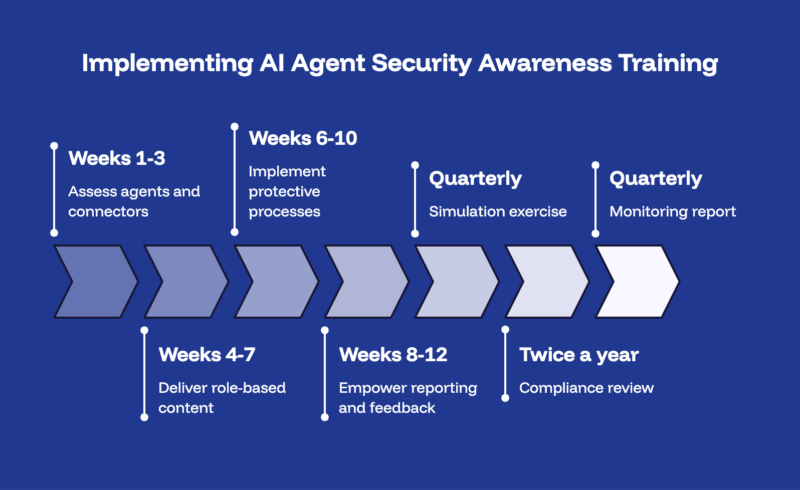
Sequence beats scope in the first 90 days. Threatcop’s AAPE framework, the execution model inside people security management, maps cleanly onto agent risk because its stages answer the questions in the order they become answerable.
Beyond the first quarter, the cadence matters more than the content. Mature awareness programs run on an annual calendar: a simulation exercise each quarter with the results analyzed the following week, a compliance review twice a year, onboarding coverage whenever headcount arrives rather than once a year, and a monitoring report every quarter that goes to someone with budget authority.
Agent scenarios slot into that calendar as another vector, alongside the seasonal phishing themes most programs already run.
Protecting the agents employees use is necessary work. It is not sufficient, because the action that causes the loss is usually authorized by a person who trusted the output in front of them. That is a behavioral control; it decays with familiarity, and the evidence now says so directly.
Baseline how your workforce approves agent actions today, then train the roles that can authorize the most damage. If you want help building that assessment and the role-based program around it, Threatcop’s security awareness training team works with organizations doing exactly this.
Existing programs supply the delivery mechanism, the audience segmentation, and the reporting culture, and all three transfer. The content does not. Phishing modules teach recognition of hostile messages, while agent risk turns on judgment about a trusted tool and on permission decisions made at provisioning time. Add agent-specific modules and metrics rather than assuming coverage.
At minimum: the list of approved agents and connectors, the data classes that may never be entered into any agent, the actions that always require human approval, the rule that credentials are never shared with an agent, a route for requesting new tools, and the reporting path for unexpected agent behavior. A policy nobody can act on in 30 seconds will be routed around.
No single global mandate exists, though sector regulators increasingly expect documented AI oversight and staff competence. Organizations subject to the EU AI Act should treat Article 4 as binding since February 2, 2025. Multinationals generally find it cheaper to run one program at the EU standard than to maintain divergent regional versions.
Nikunj is a CISO focused on helping organizations build effective security programs and resilient cultures. With a strong track record across industries, he drives governance and risk strategies that protect what matters most. Outside work, he mentors professionals and explores emerging trends shaping the future of cybersecurity.
Cyber attacks and data breaches have held the number one spot in three consecutive Aon global risk surveys, and...

AI literacy training is the set of skills that lets an employee use, question, and escalate an AI system...

AI social engineering attacks the trust between an employee and the AI tools they work with, rather than the...